Flock Safety vs. Private Property ALPR: How Virtual Gate Guard Fits into Gated Community Access Control
Automatic License Plate Recognition, or ALPR, can serve different purposes depending on how it is deployed. A community may use license plate information to manage vehicle access. Another property may use ALPR for vehicle awareness, alerts, or investigations. Public-safety organizations may also use the technology for law-enforcement purposes. This raises an important question: What is the difference between Flock Safety and private-property ALPR used for gated-community access control? Both can recognize license plates and vehicles. However, their purpose, workflow, and next steps can be very different.
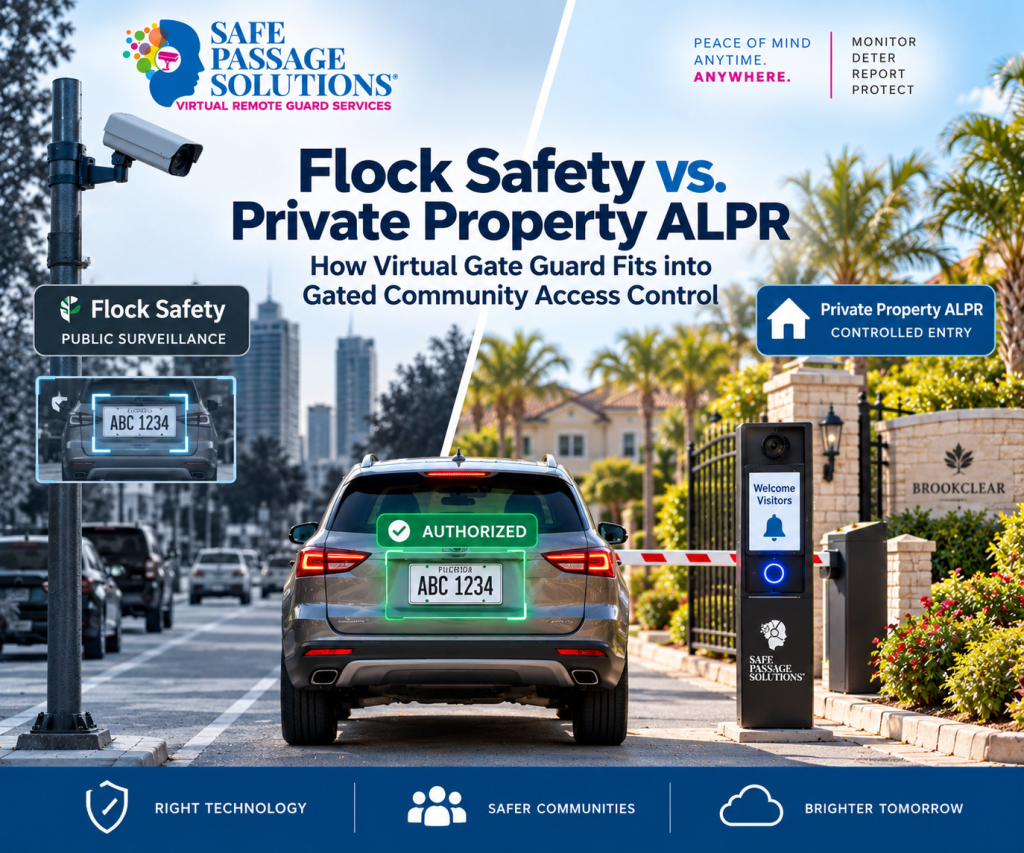
Flock Safety Uses ALPR for Vehicle Intelligence and Security
Flock Safety provides license plate recognition technology to law-enforcement agencies, businesses, neighborhoods, HOAs, and other organizations. According to Flock Safety's current LPR policy, its system can collect information such as:
- License plate images
- License plate numbers and states
- Vehicle images
- Vehicle characteristics
- Date and time
- Camera location
Flock also offers vehicle searches, alerts, investigative workflows, and other vehicle-intelligence capabilities. Flock Safety License Plate Reader Policy Its use is not limited to law enforcement. Current Flock materials also identify HOAs, neighborhoods, apartment communities, businesses, and other private organizations as users of its LPR technology. The distinction, therefore, is not simply Flock versus HOA ALPR. Flock itself provides ALPR products for residential communities. Instead, the better comparison is how the technology is used and what happens after a vehicle is recognized. Its current materials also identify HOAs, neighborhoods, apartment communities, businesses, and other private organizations as users of its LPR technology. The key distinction, therefore, is not simply Flock versus HOA ALPR. Flock itself provides ALPR products for residential communities. Instead, the better comparison is how the technology is used and what happens after a vehicle is recognized.
Private Property ALPR Can Support Controlled Entry
At a gated residential property, ALPR can support a focused access-control workflow. For example, a community may associate a resident's vehicle with an approved license plate. When that vehicle approaches the entrance, the plate can be compared with the property's current access records. The key question is: Does this vehicle match an access credential or authorization recognized by the property? This differs from using ALPR primarily for vehicle searches, alerts, or investigative purposes. However, the same technology can support different workflows. The specific use depends on the property's configuration, policies, and operational needs.
Flock Also Offers Residential Vehicle Features
For residential customers such as HOAs and neighborhood associations, Flock Safety offers a Safe List feature. The company describes it as a way for communities to identify vehicles associated with their neighborhood. According to Flock, adding a vehicle to one community's Safe List does not prevent that vehicle from being detected by other Flock cameras after it leaves the community. This shows why the overall workflow and intended use matter more than the camera technology alone. This shows why the overall workflow and intended use matter more than the camera technology alone.
Virtual Gate Guard Adds Live Communication
ALPR can provide useful vehicle information, but it cannot resolve every access question on its own. A gate team may still need to determine:
- Is the driver a resident, visitor, vendor, or contractor?
- Is the visit expected?
- Has the resident changed vehicles?
- Is the visitor going to the correct property?
- Does the request require confirmation?
- What should happen when the plate does not match the available record?
Virtual Gate Guard can provide live remote communication when human interaction is needed. Depending on the property's approved procedures, Safe Passage Solutions remote attendants may:
- Communicate with arriving visitors
- Review available access information
- Confirm the stated destination
- Confirm the purpose of the visit
- Follow approved instructions
- Contact designated parties
- Escalate unresolved requests
This allows ALPR and Virtual Gate Guard to serve different roles within the same access process. ALPR provides vehicle information. Virtual Gate Guard provides live communication when additional information or action is needed.
Vehicle Recognition Is Not the Same as Authorization
A recognized license plate provides information about a vehicle. It does not automatically determine whether the current access request should proceed. For example:
- A resident may have purchased a new vehicle.
- A former resident's plate may remain in an outdated record.
- A contractor may return after a project ends.
- A visitor may arrive in a rental vehicle.
- A vendor may use a different service vehicle.
- A readable plate may not have a current authorization record.
For this reason, private-property ALPR should operate within clear authorization procedures. A plate match is information. Authorization is the decision process surrounding that information.
ALPR Can Be Part of a Vehicle Access Credential
Traditional gated communities may use physical vehicle credentials such as:
- RFID tags
- Gate clickers
- Windshield stickers
- Barcodes
- Access cards
Depending on the property's access-control configuration, an approved license plate can serve as another credential. Instead of requiring an authorized resident to use a separate device, the community may associate the vehicle's plate with the applicable access record. In this setup, ALPR becomes part of the controlled-entry process rather than simply a tool for observing vehicle activity. It does not necessarily replace RFID, clickers, or other credentials. The appropriate configuration depends on the property's infrastructure, access policies, traffic patterns, and operational needs.
The Workflow Matters More Than the Camera
A useful way to compare ALPR deployments is to look at what happens after the plate is recognized.
| Access Question | Vehicle Intelligence / Security Use | Private Property Gate Access | | --------------- | ----------------------------------- | ---------------------------- | | What is recognized? | License plate and vehicle information | License plate and vehicle information | | Primary purpose | Vehicle visibility, alerts, searches, or investigations | Controlled entry and vehicle credentialing | | What happens after recognition? | Data may support searches, alerts, or review | Plate may be compared with property access records | | Does recognition equal authorization? | Depends on the specific workflow | Should operate within property authorization procedures | | Where can Virtual Gate Guard fit? | Not necessarily part of the workflow | Can provide live communication and exception handling |
The main differences are purpose, authorization, workflow, and the action taken after recognition.
What Happens When the Plate Does Not Match?
A proactive gate process should include procedures for common exceptions. A mismatch may occur because:
- A resident recently purchased another vehicle.
- The plate was entered incorrectly.
- A visitor is using a rental vehicle.
- A vendor sends a different service vehicle.
- The vehicle has temporary plates.
- The plate has not yet been added to the property record.
A mismatch does not automatically mean that a vehicle is unauthorized. Instead, the normal ALPR process may require additional information or human review. Depending on the community's procedures, the next step may include:
- Reviewing available visitor information
- Confirming the destination
- Contacting an authorized resident or property representative
- Requesting additional information
- Following an approved exception procedure
- Escalating an unresolved request
This is one area where Virtual Gate Guard can complement automated vehicle recognition.
Accuracy and Human Review Still Matter
ALPR systems are not infallible. Flock Safety's current policy acknowledges that license plate translation can occasionally be incomplete or inaccurate. It advises users to confirm computer-generated information before taking action based on an alert or search. Flock Safety License Plate Reader Policy The same principle can apply to private-property access control. Automated recognition should be supported by procedures for information that is incomplete, incorrect, or does not match expectations. Virtual Gate Guard can provide live communication when automated information alone does not resolve an access request.
Data Practices Are Part of the Comparison
ALPR systems can differ in how information is collected, stored, retained, accessed, and shared. For example, Flock Safety's current LPR policy states that customer LPR data is owned by the customer and that customers control sharing subject to applicable laws and policies. The policy also states that the platform's default LPR retention period is seven days unless another period applies. These details matter when evaluating an ALPR solution. Communities may want to ask:
- What information is collected?
- Why is it collected?
- How long is it retained?
- Who can access it?
- Can it be shared?
- How are access permissions managed?
- What happens when a resident or vehicle is removed?
- Is the system intended for vehicle intelligence, gate access, or both?
The answers can vary between products and individual deployments.
Frequently Asked Questions
Is Flock Safety only used by law enforcement?
No. Flock Safety also markets ALPR products to neighborhoods, HOAs, apartment communities, businesses, and other private organizations.
Is private-property ALPR the same as Flock Safety?
Not necessarily. ALPR is a technology category, while Flock Safety is one provider within that category. The important factors are how the system is configured, what information it uses, and what happens after a plate is recognized.
Does Flock offer features for HOA vehicles?
Yes. Flock Safety documents a Safe List feature for residential neighborhood customers such as HOAs and neighborhood associations.
Can a license plate become an access credential?
Yes. A private property's access-control system can associate an approved license plate with an authorized vehicle record when the system and procedures are configured for that purpose.
Can Virtual Gate Guard work alongside ALPR?
Yes. Virtual Gate Guard can support live communication and exception handling when vehicle information alone does not resolve an access request.
Can LPR replace Virtual Gate Guard?
They serve different functions. ALPR can recognize vehicle information, while Virtual Gate Guard can provide live communication for requests that require human interaction.
Does ALPR guarantee that unauthorized vehicles will never enter?
No. ALPR can support access control and vehicle awareness, but no technology can guarantee prevention of every unauthorized entry.
Key Takeaways
- ALPR is a technology category, while Flock Safety is one ALPR provider.
- Flock serves law enforcement as well as HOAs, neighborhoods, businesses, and other private organizations.
- Flock's documented capabilities include vehicle searches, alerts, investigations, and residential vehicle-awareness features.
- Private-property ALPR can support controlled entry and vehicle credentialing.
- Vehicle recognition and access authorization are separate functions.
- An approved license plate can serve as part of a private-property access credential.
- Virtual Gate Guard can provide live communication when ALPR alone cannot resolve an access request.
- Communities should evaluate ALPR based on purpose, workflow, authorization, data retention, access, and sharing practices.
Final Thoughts
The question is not simply Flock Safety versus ALPR. Flock Safety itself uses ALPR and offers products to both public-safety and private residential customers. A better comparison looks at how the technology is deployed and what happens after a plate is recognized. One deployment may emphasize vehicle awareness, searches, alerts, or investigative information. Another may use an approved license plate as part of a private-property access credential. For gated communities, an important question is: What happens after the plate is recognized? Private-property ALPR can support vehicle-based access credentials and controlled entry. Virtual Gate Guard can add live communication and exception handling when automated recognition does not provide enough information to complete the access process. Safe Passage Solutions can help communities evaluate how Virtual Remote Guard and License Plate Recognition may work together as part of a gated-community access strategy.